

AI Search and the Future of Automotive Retail — Part 2
By Peter “webdoc” Martin
President, Cactus Sky Digital | Co-Host & CMO, AutoHubShow
In my last article, I talked about something that should be getting the attention of every dealer principal, general manager, and automotive marketing director in the country.
Consumers are changing how they search for vehicles.
Instead of starting their shopping experience with a Google search for "Ford dealer near me" or "new SUVs for sale," more consumers are turning to ChatGPT, Google Gemini, and other AI-powered platforms to help them decide what vehicle to buy and where to buy it.
After attending CXAUTO, Automotive News Congress Week, and Reuters Events Automotive USA in Detroit, I've been thinking a great deal about what this means for the dealerships that have spent years investing in websites, SEO, paid search, and digital marketing.
Here's the question I want every dealer to consider:
Have you actually asked ChatGPT whether it would recommend your dealership?
Not whether ChatGPT knows your dealership exists.
Not whether it can find your website when you provide the dealership's name.
I'm talking about whether your dealership appears when a consumer asks AI for help deciding where to purchase a vehicle.
There's a very big difference.
Your Dealership May Be Missing From a Conversation You Never Knew Was Happening
Imagine a consumer living in Jacksonville, Florida, who's interested in buying a new pickup truck.
Ten years ago, that consumer probably would have searched Google for Ford dealerships in Jacksonville, visited a few websites, compared inventory, and submitted an inquiry.
Today, that consumer might open ChatGPT and ask:
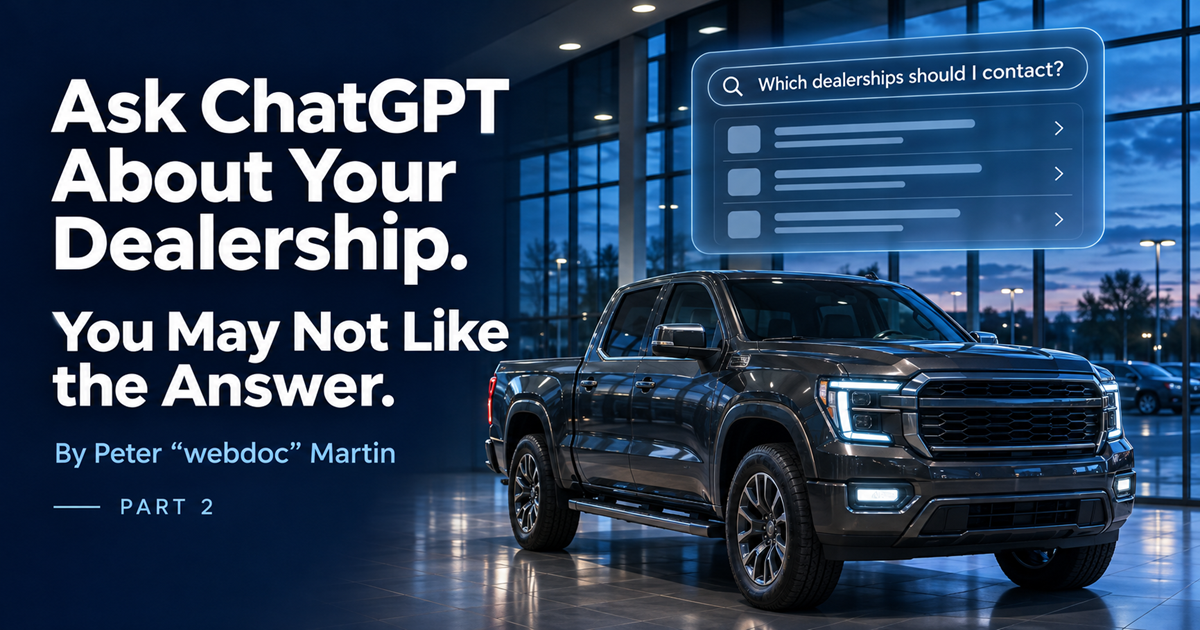
"I'm looking for a new full-size pickup truck under $60,000. I want something reliable, comfortable for highway driving, and capable of towing a boat. What models should I consider, and which dealerships around Jacksonville should I contact?"
Think about what's happening.
The consumer isn't asking for a list of Ford dealerships.
They're asking for advice.
An AI-powered search tool may compare the Ford F-150, Chevrolet Silverado, Ram 1500, and Toyota Tundra. It may discuss towing capacity, engine options, fuel economy, ownership costs, and features.
And depending on the platform, available information, and search capabilities, it may identify dealerships worth considering.
Now imagine three dealerships are mentioned.
Yours isn't one of them.
How much business could you be losing without ever knowing you had an opportunity to compete?
That's the issue I believe dealers need to understand.
We have spent decades measuring the customers who visit our websites, submit leads, call our dealerships, and walk into our showrooms.
But how do we measure the customers who never discover us because an AI-powered search experience directs their attention somewhere else?
Being Number One on Google Doesn't Mean You're Number One With AI
For years, dealers have been conditioned to think about search visibility in terms of rankings.
Where do we rank for our dealership name?
Where do we rank for "new Toyota Camry near me"?
Are we appearing in the Google Map Pack?
Are our paid search campaigns producing traffic?
Those questions still matter.
But AI-generated answers don't necessarily work like traditional search results.
Instead of presenting ten blue links, an AI platform may generate a detailed response based on information it can access and evaluate.
That information may include manufacturer websites, dealership websites, automotive publications, third-party marketplaces, business listings, and customer reviews.
And while traditional SEO remains an important foundation, a dealership's position in conventional search results doesn't guarantee that it will appear in an AI-generated answer.
This is where Answer Engine Optimization, or AEO, becomes increasingly important.
SEO helps people find your website. AEO helps make your dealership's information useful when AI systems answer consumers' questions.
The two work together, but dealers need to understand the distinction.
Here's an Experiment Every Dealer Should Try This Week
I would encourage every dealer principal and general manager reading this article to spend 20 minutes conducting a simple experiment.
Open ChatGPT with web search enabled, Google AI Mode, or another AI-powered search tool.
Don't start by entering your dealership's name.
Instead, think like a consumer who doesn't know your dealership exists.
Ask questions such as:
Question 1:
"What are the best dealerships near me to purchase a new Honda CR-V, and why would you recommend them?"
Question 2:
"Which Ford dealerships in my area have a good reputation for customer service and competitive pricing?"
Question 3:
"I'm looking for a new SUV under $45,000 with excellent safety features. What vehicles should I consider, and where can I buy them locally?"
Question 4:
"Which dealerships near me have a strong selection of new pickup trucks and offer a convenient online buying experience?"
Question 5:
"Compare the dealerships in my area that sell the vehicle I'm interested in. Which ones should I contact first?"
Now look carefully at the answers.
Does your dealership appear?
Are your competitors mentioned?
Is the information about your dealership accurate?
Are the recommendations supported by sources?
Does the AI tool reference your website, your inventory, your reviews, or third-party information?
And perhaps most importantly, does it provide a compelling reason for a consumer to consider doing business with you?
Don't assume one answer tells the whole story. AI-generated responses can change based on the question, location, platform, and available information.
Run several searches and compare the results.
The goal isn't to prove that AI likes or dislikes your dealership.
The goal is to understand whether your dealership is visible during the new automotive shopping process.
What Determines Whether AI Mentions Your Dealership?
This is where things get interesting.
There isn't one universal formula that determines which dealerships AI platforms recommend.
Different systems use different information sources and retrieval methods, and they don't disclose every factor influencing their responses.
However, there are several areas dealers can evaluate and improve.
First, your dealership's digital identity.
Is your dealership's name, location, contact information, hours, and brand affiliation consistent across the internet?
Second, your inventory information.
Can search platforms access accurate information about the vehicles you have available?
Third, your dealership's reputation.
What information is publicly available about your customer experience? Are your reviews current and credible?
Fourth, your website content.
Does your website answer meaningful questions about the vehicles you sell, or does it primarily consist of inventory listings and promotional advertisements?
Fifth, your dealership's online authority.
Are credible third-party sources mentioning your dealership? Is your business represented accurately across manufacturer directories, automotive platforms, and local business resources?
None of these factors guarantees a recommendation.
But together, they form an important foundation for making your dealership easier to discover, understand, and evaluate.
Stop Measuring Only the Traffic You Receive
One of the biggest changes dealers need to make is how they think about digital marketing performance.
For years, we've measured success through website sessions, clicks, vehicle detail page views, leads, and conversions.
Those metrics remain important.
But they don't necessarily tell us whether a dealership is being considered in AI-generated recommendations.
I believe dealerships should begin tracking an additional set of measurements.
How frequently does our dealership appear in relevant AI search responses?
Which competitors appear more frequently?
Are AI systems citing our dealership website?
Are the vehicles and services they mention accurate?
Are consumers arriving at our website from AI-powered platforms?
And can we connect those interactions to qualified leads, appointments, and vehicle sales?
We're still in the early stages of developing consistent measurement standards for AI search.
But waiting until the industry has a perfect measurement system is not a strategy.
We need to start establishing baselines now.
The Opportunity Is Bigger Than Just Getting Mentioned
I want dealers to understand something else.
The objective shouldn't be to manipulate an AI system into recommending your dealership.
The objective should be to make your dealership a genuinely valuable source of information for consumers.
If you're a Ford dealership, you should have meaningful information about Ford vehicles, trim comparisons, towing capabilities, ownership costs, available inventory, and the services that differentiate your dealership.
If you're a Honda dealership, you should be answering the questions consumers are asking about the CR-V, Civic, Accord, Pilot, and other models.
And if your dealership offers advantages such as extended service hours, convenient delivery options, or specialized customer services, that information should be clearly documented and easy to verify.
We need to think beyond keywords and start thinking about answers.
Because when a consumer asks AI for help purchasing a vehicle, the dealership that provides the most useful and credible information may be better positioned to earn consideration.
What I Want Dealers to Do Next
Before spending another dollar on a new AI marketing product, start with an honest assessment of your dealership's visibility.
Test the questions consumers are actually asking.
Look at the sources AI systems use.
Compare your dealership's presence with competitors.
Identify inaccurate or missing information.
Then work with your marketing team or agency to develop a plan.
You don't need to abandon your current marketing strategy.
You need to expand it to account for how consumers are beginning to search.
I've watched automotive marketing evolve for more than 30 years, and one thing has remained consistent.
The dealers who recognize changes in consumer behavior early are generally better positioned to respond than those who wait until everyone else has moved.
AI-powered vehicle discovery is one of those changes.
Here's my challenge: Ask ChatGPT where someone should buy a new vehicle in your market. If your dealership isn't part of the answer, it's time to find out why.