

Why AI Search and Answer Engine Optimization Are Becoming Critical to Automotive Retail
By Peter Martin
President, Cactus Sky Digital | Co-Host & CMO, AutoHubShow
Over the past several weeks, I've had the opportunity to attend two major automotive industry gatherings in Detroit: CXAUTO 2026 and Automotive News Congress Week in September, followed by Reuters Events Automotive USA in October.
Between the executive presentations, interviews, panel discussions, and conversations with industry leaders, one theme continued to stand out: artificial intelligence is fundamentally changing the automotive industry.
We talked about AI in vehicles, customer experience, connected technology, digital retailing, dealership operations, and how consumers interact with automotive brands.
But as I listened to these conversations, I kept coming back to a question that I believe deserves much more attention from dealers.
What happens when the consumer looking for their next vehicle stops searching the way we've spent the last 25 years teaching them to search?
I'm not talking about a change in Google's algorithm or another adjustment to a dealership's digital marketing strategy.
I'm talking about a fundamental change in how consumers discover vehicles, evaluate their options, and decide which dealership deserves their business.
And I believe many dealers are not prepared for what's coming.
The Search Process Is Already Changing
For years, automotive digital marketing has revolved around a relatively predictable process.
A consumer decides they need a vehicle. They go to Google and search for something like "Ford dealer near me," "best price on a Honda CR-V," or "new Toyota Camry for sale."
They see paid advertisements, organic search results, dealership websites, and third-party automotive marketplaces.
The dealership's job has been to appear prominently in those results, attract the consumer to its website, get them to view inventory, and ultimately generate a lead.
We've built an entire automotive marketing industry around that process.
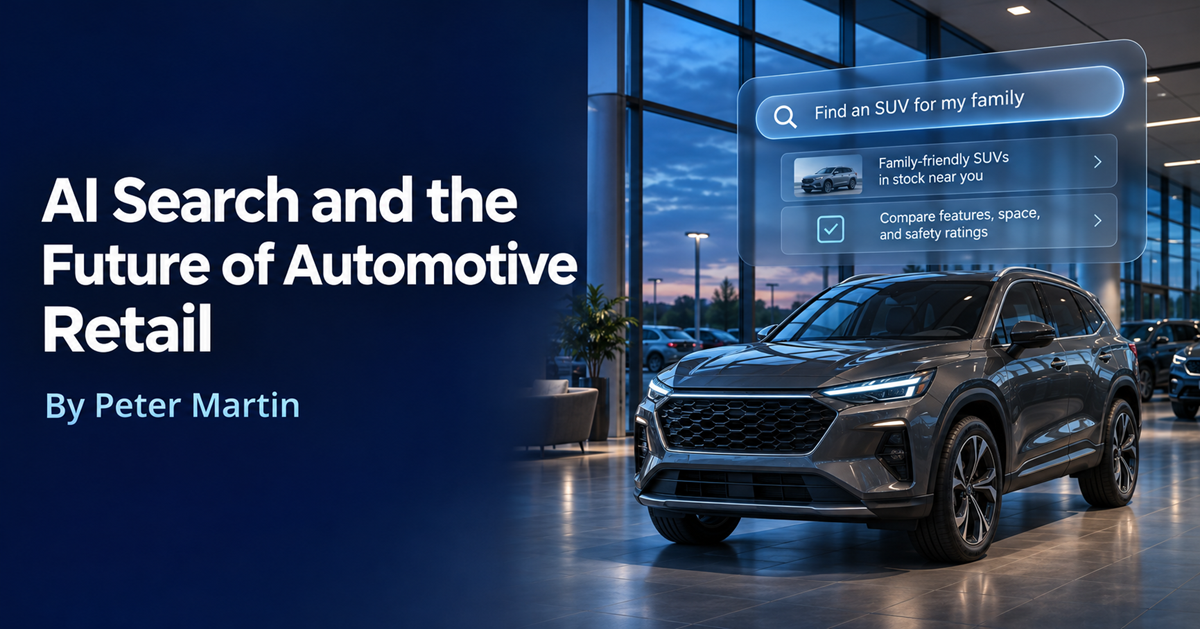
Now consider what happens when that same consumer opens ChatGPT, Google Gemini, or another AI-powered search tool and asks:
"I'm looking for a new SUV under $40,000. I have two kids, drive about 20,000 miles a year, want good fuel economy, and plan to keep the vehicle for at least seven years. What should I buy, and where should I buy it?"
Think about the difference.
The consumer isn't searching for a dealership.
They're asking AI to help them make a buying decision.
The AI system can explain vehicle options, compare models, discuss ownership costs, identify features, and potentially suggest dealerships to investigate.
Instead of visiting five or six dealership websites to begin their research, consumers may narrow their choices before they ever click on a dealer's website.
That changes everything about how dealerships need to think about being found online.
From SEO to AEO: A Change Dealers Need to Understand
Most dealers are familiar with Search Engine Optimization, or SEO.
For years, we've invested in SEO to improve dealership visibility when consumers search for vehicles, services, and dealership locations.
That work remains important.
But there's another discipline dealers need to understand: Answer Engine Optimization, or AEO.
Traditional SEO focuses on helping your dealership appear in search results.
AEO focuses on making your dealership's information understandable, credible, and useful to AI-powered systems that generate answers to consumer questions.
Here's the distinction.
With traditional SEO, the goal might be to rank for "new Ford F-150 Jacksonville."
With AEO, the opportunity is to be considered when someone asks:
"Which dealership near Jacksonville has a good selection of new F-150 trucks, offers competitive pricing, and has a strong reputation for customer service?"
That's a much more complicated question.
The AI system may consider information from dealership websites, manufacturer resources, inventory listings, third-party automotive sites, reviews, and other publicly available sources.
And here's what should concern dealers.
Your dealership could have an excellent website, a substantial advertising budget, and strong traditional search rankings—and still be missing from the AI-generated answers consumers receive.
There is no guarantee that ranking well on Google automatically means your dealership will be recommended by an AI assistant.
There is also no guarantee that an AI system will always provide accurate information.
But the shift in consumer behavior is real, and dealers need to start preparing.
The Numbers Should Get Every Dealer's Attention
Recent research from Cox Automotive illustrates just how quickly this environment is developing.
Its 2026 AI in Auto Retail research found that 63% of consumers indicated they were likely to use AI during their next vehicle purchase.
Meanwhile, only 29% of dealers reported actively adapting, or being in the process of adapting, their approach to AI-powered search.
That's a significant disconnect.
Dealers have spent years investing in websites, search advertising, inventory platforms, and digital marketing technology.
But consumers are beginning to use tools that can change how they interact with all of those investments.
What happens if a dealership's inventory isn't properly understood by an AI search platform?
What happens if its pricing information is inconsistent across websites?
What happens if competitors have better information available about their vehicles, customer experience, or services?
And what happens when an AI assistant recommends three dealerships, but yours isn't one of them?
These are questions dealers need to start asking today.
Your Inventory Is No Longer Enough
One of the most interesting conversations I participated in at CXAUTO involved the evolution of the digital showroom.
We discussed why today's automotive shoppers need more than vehicle photos and basic inventory descriptions.
Consumers want meaningful information. They want transparency, personalized experiences, useful video, and answers to questions that help them make decisions.
That conversation becomes even more important when we look at AI search.
Think about how most dealership inventory is presented today.
A typical vehicle detail page includes the year, make, model, trim, color, equipment, pricing, and photographs.
That's important information, but it doesn't necessarily answer the questions consumers are asking AI.
A consumer might ask:
"Which three-row SUVs have the most room for teenagers?"
"Is the hybrid version worth the additional cost if I drive 18,000 miles a year?"
"What's the difference between the two trim levels, and which one offers the best value?"
"Which dealerships have this vehicle available and can arrange a test drive this weekend?"
The dealerships that provide accurate, comprehensive, accessible information relevant to these questions will be better positioned to participate in AI-driven discovery.
That means inventory descriptions, comparison content, ownership information, dealership reputation, and the technical structure of a website all deserve renewed attention.
And it means we need to stop thinking about dealership content simply as something we publish to attract search traffic.
We need to start thinking about content as information that helps AI systems understand what our dealerships offer and why consumers should consider doing business with us.
The Biggest Threat May Be the Customer You Never Knew Existed
Here's what concerns me most.
For decades, dealers have measured digital marketing success through website traffic, vehicle detail page views, form submissions, phone calls, and showroom visits.
But what happens when a consumer researches vehicles through AI and never encounters your dealership?
You won't necessarily see a lost lead in your CRM.
You won't receive an abandoned shopping-cart notification.
You may not even know your dealership was excluded from the consumer's consideration.
The consumer simply moves forward with another dealership.
That's why I believe AI search visibility needs to become part of every dealership's marketing conversation.
Not because SEO is dead. It isn't.
Not because every consumer is going to purchase a vehicle through ChatGPT. They aren't.
But because the research and consideration process is evolving, and dealers cannot afford to ignore a new way consumers are discovering products and businesses.
Five Questions Every Dealer Should Be Asking
Before investing in another marketing campaign, I would encourage every dealer principal, general manager, and marketing director to ask five questions.
1. When consumers ask AI about vehicles in our market, does our dealership appear in the answers?
Not just when they search for our dealership by name, but when they ask questions about the vehicles we sell.
2. Can AI search platforms accurately understand our inventory?
Are our vehicle listings accessible, current, and detailed enough to answer meaningful consumer questions?
3. Are we creating content that actually answers shoppers' questions?
Or are we still publishing generic articles designed primarily around keywords?
4. Is our dealership information consistent and credible across the internet?
Our website is only one source of information. Reviews, business listings, manufacturer resources, and third-party platforms can all influence how consumers—and AI systems—understand our business.
5. How are we measuring our visibility in AI-generated search results?
If we don't know whether our dealership is being mentioned, cited, or recommended, how can we improve?
These are practical questions, and answering them is a good place to start.
This Is Not About Replacing Everything Dealers Are Doing
I want to be clear about something.
I'm not suggesting dealers abandon traditional SEO, paid search, third-party marketplaces, or the marketing programs that are producing results.
Quite the opposite.
AEO should build on a strong digital marketing foundation.
Dealerships still need accurate inventory, effective websites, strong local search visibility, credible reviews, and a process for converting consumer interest into appointments and sales.
What changes is how we organize that information, how we create content, and how we measure whether consumers can discover us through AI.
And there is an important distinction between helping an AI system find accurate information and guaranteeing that it will recommend your dealership.
No legitimate marketing company can promise that every AI assistant will recommend a particular dealership.
What we can do is improve the quality, accessibility, consistency, and usefulness of the information those systems may rely on.
That's where dealers should begin.
The Next Evolution of Automotive Marketing Is Already Underway
I've been involved in automotive marketing for more than 30 years.
I've watched our industry move from traditional direct marketing to email, from print advertising to digital, from basic dealership websites to sophisticated inventory platforms, and from desktop search to mobile-first shopping.
Every major transition created challenges.
Every transition also created opportunities for dealers willing to recognize what was changing and adapt before their competitors.
I believe AI-powered search represents another one of those transitions.
My experiences at CXAUTO, Automotive News Congress, and Reuters Automotive USA reinforced just how quickly AI is becoming part of the automotive conversation.
Now we need to make sure dealership marketing and customer acquisition receive the same attention.
Because the next customer searching for a vehicle may not begin by searching for your dealership.
They may begin by asking AI which vehicle they should buy.
And the dealerships that understand how to participate in that conversation will be better prepared for the future.
The question every dealer needs to ask is simple: When AI helps a consumer decide where to buy their next vehicle, will your dealership be part of the answer?
About This Series: AI Search and the Future of Automotive Retail
This is the first article in a continuing series examining how artificial intelligence is changing vehicle discovery, dealership marketing, and the automotive buying process.
In upcoming articles, I'll explore how AI-powered search platforms find dealership information, what dealers can do to improve their AEO visibility, how vehicle inventory and content need to evolve, and how dealerships can measure their presence in AI-generated answers.
My goal is to move beyond the hype and help dealers understand the practical steps they can take today.
Peter Martin
President, Cactus Sky Digital
Co-Host & CMO, AutoHubShow
Research reference: Cox Automotive, 2026 AI in Auto Retail Tracker.