

AI is changing how customers discover businesses, evaluate solutions, and make purchasing decisions. For dealerships and automotive vendors, being visible in AI-generated answers is becoming just as important as appearing in traditional search results. But achieving that visibility requires more than a few SEO adjustments.
Over the past several articles, we've explored three essential components of AI visibility: content, infrastructure, and monitoring. Together, they form the foundation of a practical strategy for automotive businesses looking to strengthen their presence across platforms such as ChatGPT, Gemini, and Perplexity.
One thing is becoming increasingly clear: there is no shortcut to AI visibility. No single tool, technical adjustment, or content strategy can guarantee that an AI platform will recommend your company.
Instead, AI visibility must become an ongoing business discipline.
1. Create Content Worth Referencing
Effective AI visibility starts with authoritative, relevant, and genuinely useful content.
Publishing articles simply to meet a content quota is no longer enough. Automotive businesses need to focus on answering real customer questions, sharing original research, demonstrating industry expertise, and providing information that competitors cannot easily replicate.
Consider this question when evaluating your website content:
Why would an AI platform reference your article instead of ten others covering the same subject?
If the answer isn't clear, there may be an opportunity to improve the content.
For automotive dealerships, valuable content could include service trends, frequently asked customer questions, EV maintenance insights, or real-world examples from fixed operations.
For automotive technology vendors, it might include industry benchmarks, campaign performance data, customer success stories, or research gathered across multiple dealership clients.
The goal is to become a credible source of information that both customers and AI systems can recognize as valuable.
2. Make Your Website Accessible to AI Systems
Even exceptional content has limited value if the systems retrieving information cannot access it.
This is where website infrastructure becomes a critical part of an AI visibility strategy.
Marketing teams should work closely with developers and IT professionals to evaluate how their websites are accessed and interpreted by search engines and AI-related crawlers.
Important areas to review include:
Robots.txt settings and crawler permissions
Content delivery networks (CDNs) and firewall configurations
Bot-management and security rules
JavaScript rendering and server responses
Canonical URLs and XML sitemaps
Structured data and schema markup
Website performance and caching configurations
A website may appear perfectly functional to human visitors while presenting incomplete information or access restrictions to automated systems.
The key is to verify what relevant crawlers and retrieval systems can actually access rather than assuming that everything is working correctly.
3. Monitor What AI Says About Your Business
Traditional SEO reporting focuses heavily on rankings, impressions, traffic, and clicks.
AI visibility introduces another important measurement: whether your company appears in the answers customers receive.
Automotive businesses should begin monitoring relevant questions across major AI platforms.
For example, a dealership might test:
Which dealerships in my area specialize in electric vehicle service?
Where can I find a dealership offering mobile vehicle maintenance?
Which local dealerships are known for excellent service experiences?
An automotive vendor might ask:
Which companies provide automotive recall marketing solutions?
What are the leading AI communication platforms for dealerships?
Which providers specialize in dealership customer retention technology?
The objective is to identify which businesses are mentioned, what sources are cited, how accurately companies are represented, and where competitors may have stronger visibility.
Because AI responses can vary between platforms and over time, consistent testing is more valuable than relying on a single result.
Tracking these findings in a regular scorecard can help identify content gaps, emerging opportunities, and changes in brand visibility.
4. Build a Continuous AI Visibility Improvement Cycle
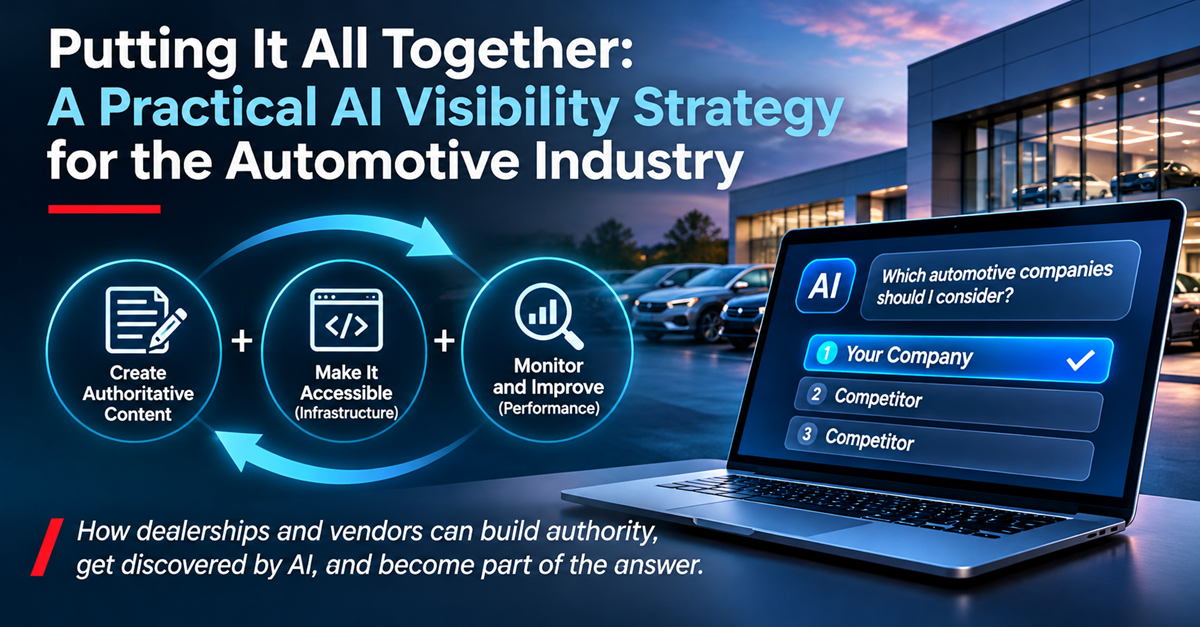
The strongest AI visibility strategies connect content creation, technical accessibility, and performance monitoring into one continuous process.
It begins with publishing useful, authoritative information. The website's infrastructure makes that information accessible to relevant systems. AI platforms may then retrieve, reference, or cite that content when answering related questions.
By monitoring those responses, businesses can identify where their information is appearing and where important gaps remain.
Those findings can guide future content development, technical improvements, and authority-building efforts.
Publish. Optimize. Monitor. Learn. Improve. Repeat.
This process transforms AI visibility from a one-time marketing project into a measurable, ongoing strategy.
5. Turn Dealership Experience Into Valuable Content
Automotive dealerships have an advantage that many businesses overlook: access to extensive real-world operational knowledge.
Every department generates information that could be useful to customers and industry professionals.
Service advisors understand why customers decline recommended maintenance. Technicians recognize recurring repair issues. BDC teams hear common questions about appointments and vehicle ownership. Mobile service departments understand which services customers value most.
Instead of allowing this knowledge to remain inside the dealership, businesses can turn it into original content.
Potential article topics include:
"The 10 Most Common Reasons Customers Decline Recommended Vehicle Service"
An analysis based on actual service advisor experiences and dealership data.
"What Our Mobile Service Technicians Accomplished This Year"
A practical look at services performed, customer demand, and emerging mobile maintenance trends.
"Five Questions Customers Ask Most Often About EV Maintenance"
An educational resource built around real conversations between customers and dealership service teams.
This type of content demonstrates expertise while answering questions that customers may already be asking AI assistants.
6. Automotive Vendors Can Become Industry Authorities
Automotive technology and service providers have another significant opportunity.
Many vendors work with hundreds or thousands of dealerships, giving them access to aggregated insights that individual dealerships may not possess.
When handled responsibly and with appropriate permissions, this information can become a valuable source of industry research.
Email marketing providers could publish dealership engagement benchmarks. Fixed operations technology companies could share repair order trends. AI communication providers could report on customer response patterns.
Rather than producing promotional articles disguised as educational content, vendors can publish original findings that help the industry understand what is happening.
When trade publications, industry executives, and other credible websites reference that research, the company strengthens its broader reputation and digital authority.
These references can also create additional opportunities for its information to be discovered and cited by AI systems.
The objective is simple: become a company the industry turns to for reliable information.
7. Look Beyond Website Traffic to Measure Success
For decades, digital marketing performance has been measured primarily through clicks, website visits, and conversions.
AI-generated answers are beginning to challenge that model.
A potential customer may ask an AI assistant to recommend automotive technology providers and receive a shortlist of companies without immediately visiting any of their websites.
If your company appears in that recommendation, it may influence the customer's purchasing decision before a traditional website interaction occurs.
That creates value that conventional analytics may not fully capture.
Automotive marketers should begin evaluating additional indicators, including AI brand mentions, citation frequency, share of visibility across relevant questions, accuracy of company descriptions, and competitor comparisons.
These metrics should complement established performance measures rather than replace them.
The challenge is to understand not only how many people visit your website, but also how frequently your company becomes part of the research and consideration process.
8. Make AI Visibility a Company-Wide Priority
AI visibility cannot be managed effectively by marketing teams alone.
It requires collaboration between departments.
Marketing professionals understand the audience and content strategy. Developers and IT teams maintain technical accessibility. Subject-matter experts contribute original knowledge. Leadership helps establish priorities and supports long-term investment.
When these functions work together, businesses can create stronger information resources, resolve technical barriers, and respond more effectively to changes in AI discovery.
For automotive organizations, this collaboration will become increasingly important as AI tools evolve.
The Time to Start Is Now
AI platforms will continue to change. Their retrieval methods, citation behavior, and underlying technologies will evolve, and new tools will enter the market.
There is unlikely to be one permanent set of rules that guarantees AI visibility.
However, the fundamentals are already clear enough for automotive businesses to take action.
Create useful information. Make it accessible. Demonstrate expertise. Build credibility. Monitor AI-generated answers. Use those insights to improve continuously.
The automotive industry has experienced countless technological changes, and the businesses that adapt successfully often share similar characteristics: they pay attention early, experiment, measure results, and refine their strategies.
AI visibility should be approached the same way.
The most important question is no longer simply whether customers can find your website on Google.
It's whether your company is part of the answer when someone asks AI about the products, services, or solutions you provide.
And if your company isn't appearing in those answers, the next question is even more important:
Do you know why?