



Practical Guidance for Fixed Ops Leaders Navigating Data, Accuracy, and Retention
As we look ahead to 2026, fixed operations leaders face a familiar challenge that continues to grow more complex. Service marketing has become more important than ever, yet many dealerships are still relying on DMS driven programs that were never designed to support modern marketing expectations. The result is wasted spend, missed opportunities, and inconsistent retention.
The issue is not a lack of effort or intent. Most dealerships are marketing regularly. The problem is that the data inside the DMS often cannot support accurate, targeted, or relevant communication. Until that reality is addressed, even well-planned campaigns will struggle to deliver consistent results.
The State of DMS Data in Fixed Operations
The DMS remains the central system of record for dealership operations. It stores customer information, vehicle ownership, service history, and repair activity. It is also where most service marketing audiences originate.
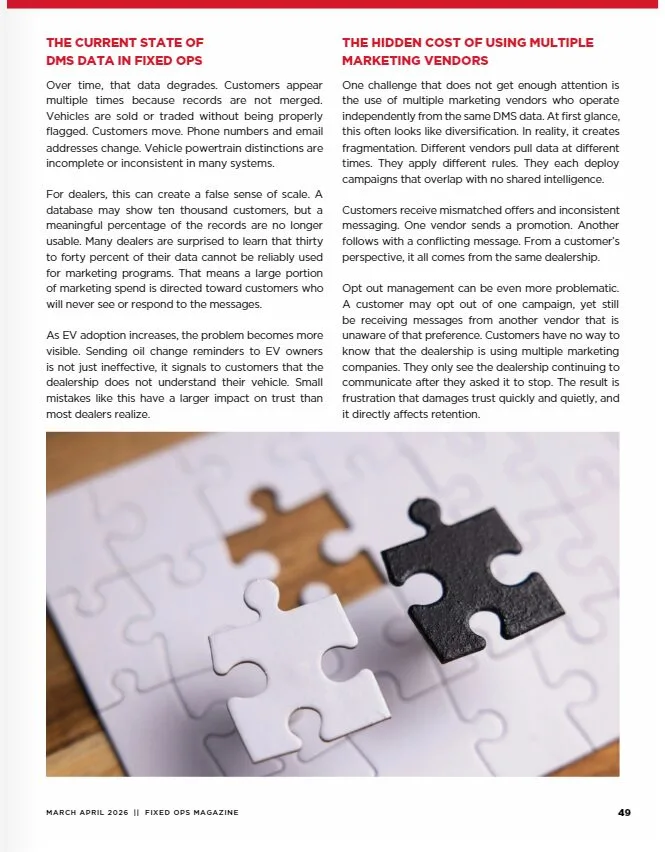
Over time, however, DMS data becomes fragmented. Customers appear multiple times because records are not merged. Vehicles are sold or traded without being flagged. Customers move out of market. Email addresses and phone numbers become outdated. In many systems, powertrain distinctions such as EV versus ICE are not consistently maintained.
For dealers, this creates a false sense of scale. A database may show ten thousand customers, but a meaningful percentage of those records may no longer be usable. Many dealers are surprised to learn that thirty to forty percent of their data cannot be reliably marketed to. That means a large portion of marketing budgets are directed toward customers who will never see or respond to the message.
As EV adoption increases, the consequences become more visible. Sending an oil change message to an EV owner is not just ineffective, it damages credibility. Customers notice when the dealership does not appear to understand their vehicle.
Why Data Quality Impacts More Than Marketing
Poor DMS data affects more than campaign performance. It impacts the entire fixed operations ecosystem.
Service advisors often lack a complete or accurate customer view. BDC teams spend time calling disconnected numbers or customers who no longer own the vehicle. Duplicate records create confusion in reporting and attribution. Leadership teams struggle to determine what marketing efforts are actually driving traffic.
From the customer’s perspective, irrelevant or repetitive communication feels careless. In a competitive service environment where customers can choose from multiple independent options, those small frustrations add up. Retention erodes quietly, often without a clear warning sign.
Rethinking DMS Marketing for 2026
Improving DMS marketing does not require reinventing the dealership. It requires a shift in mindset. Fixed ops leaders must move away from the idea that more messages equal better results. The focus needs to be on accuracy, consistency, and accountability.
Here are several practical recommendations dealers can act on as they prepare for 2026.
Make Data Hygiene a Discipline, Not a Project
Data cleanup cannot be an occasional exercise. Customer data degrades continuously. Ownership changes. Contact details evolve. Without routine validation, the database loses value.
Dealerships should implement an ongoing process to deduplicate records, verify ownership, update addresses, and remove unreachable contacts. Marketing to fewer, verified customers consistently produces better results than blasting a large but inaccurate list.
A simple question every dealer should ask is how often their marketing data is validated and how much of it is truly marketable.
Create a Unified Customer Profile
Multiple records for the same customer undermine both service operations and marketing. Every dealership should strive for a single customer profile that reflects the full relationship across service visits, vehicle ownership, and communication history.
This requires more than pulling lists. It requires identity resolution so that each interaction updates the same record. When that happens, advisors see accurate histories, segmentation improves, and reporting becomes meaningful.
Segment by Vehicle Reality
As vehicle technology evolves, service marketing must follow. EVs, hybrids, and ICE vehicles require different communication strategies. Maintenance needs differ. Ownership behavior differs.
Effective DMS marketing clearly distinguishes between powertrain types and service requirements. Generic offers may be easy to deploy, but they underperform and weaken trust. The same principle applies to warranty status, time since last visit, declined services, and geographic proximity.
Precision segmentation drives relevance, and relevance drives response.
Focus on Consistent Omnichannel Presence
Service marketing is not driven by impulse. Customers respond to familiarity and convenience. Trying to predict a single perfect moment is less effective than maintaining consistent presence.
An effective approach uses multiple channels that reinforce one another. Direct mail, email, text, digital, and BDC outreach should all work from the same customer intelligence. The message remains consistent. The dealership stays top of mind.
Consistency outperforms guesswork, especially in fixed operations.
Demand Transparent Attribution
One of the most common frustrations dealers express is unclear reporting. If a provider takes credit for every RO, the data is not useful.
Effective attribution distinguishes between routine visits and influenced behavior. A customer who has not serviced in over a year and returns after targeted outreach represents a different outcome than a regular maintenance visit.
Dealers should insist on reporting that reflects reality, even when it is uncomfortable. Honest measurement is the foundation of improvement.
Align Marketing With Fixed Ops Goals
DMS marketing should support specific fixed operations objectives. Increasing express service traffic. Improving recall completion. Recovering declined services. Protecting loyal customers from defection.
Marketing that operates independently of service strategy rarely performs well. When marketing is aligned with operational goals, it becomes an extension of the service department rather than a disconnected activity.
Looking Ahead
The future of DMS marketing in fixed operations will be defined by precision and accountability. AI and automation will continue to evolve, but their effectiveness will always depend on data quality and process discipline.
Dealers who succeed in 2026 will not be those who send the most messages. They will be the ones who understand their customers best, communicate consistently, and measure results honestly.
The most important question for any fixed ops leader is straightforward. Is your DMS data helping you drive retention, or are you working around its limitations.
Answering that question honestly is the first step toward more effective DMS marketing in the year ahead.

AS FEATURED IN FIXED OPS MAGAZINE
– MARCH/APRIL 2026