As the automotive world gears up for the NADA 2026 convention, one thing is clear: artificial intelligence (AI) is shifting from buzzword to business reality on dealership floors. In the past few years, AI-driven tools have exploded onto the scene, promising to streamline car sales and service.
I am going to cut through the hype and give you a high-level look at how AI is expected to reshape U.S. auto retail in 2026.
In this editorial overview, we’ll explore the rapid rise of AI applications for dealerships, the crowded vendor landscape you’ll encounter at NADA, what AI can and can’t do for your store, and how to evaluate AI solutions wisely. Consider this your friendly guide to navigating the AI revolution with confidence and a clear-eyed game plan.
AI’s Rapid Rise in Dealerships
AI is no longer a distant promise for dealerships, it’s here now, embedded across operations from sales to service. Industry surveys show that over 80% of dealers plan to invest in AI technology by 2025. Dealers who have already embraced these tools are seeing real benefits.
As one recent NADA report put it, “AI is no longer nice to have, it is critical to have,” with early adopters enjoying vast improvements in efficiency. Every dealership’s role is feeling the impact: salespeople, service advisors, BDC reps, all are finding parts of their workflow augmented (or automated) by AI. But what do these AI applications actually look like on the ground?
Here are some of the breakout AI solutions making waves in dealerships:
- Virtual Assistants (Chatbots & Voice Bots): AI-powered assistants on your website or phone lines that engage customers 24/7, answering questions and guiding them, whether it’s midnight web chat or an after-hours call.
- Instant Lead Engagement: AI lead response systems that automatically follow up with internet leads within seconds, via text or email, with personalized answers and appointment suggestions.
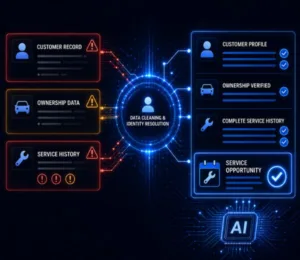
- Predictive Service Scheduling: Intelligent maintenance tools that monitor vehicle data and service history to predict when a customer’s car will need work.
- Marketing Automation & Personalization: AI-driven marketing platforms that analyze shopper behavior and automate ad targeting and creative testing.
- Inventory Pricing & Analytics: Pricing tools powered by machine learning that continuously crunch market data, pricing trends, and shopper behavior.
- Back-Office Automation: AI isn’t just customer-facing, it’s also streamlining the administrative side of the house.
All of these applications were barely on the radar a decade ago. Now they’re not science fiction, but off-the-shelf solutions being implemented in stores across the country. AI is truly redefining how dealers operate day-to-day, from how we greet customers to how we crunch numbers in the back office.
An AI Gold Rush at NADA 2026 and Beyond
If you attended last year’s NADA convention, you probably noticed that AI was the star of the show. The 2025 NADA expo in New Orleans, AI was everywhere you turned. On the expo floor, hundreds of companies were showcasing some kind of AI-powered product or platform. Stroll down any aisle, and you’d see AI chatbots, AI phone assistants, AI-driven marketing dashboards, AI F&I menu tools, you name it.
Many long-established dealership technology providers have baked AI into their offerings, and countless new players have entered the arena with AI-specific solutions. The result is a crowded, noisy vendor landscape. Dealers heading to the NADA 2026 expo should expect even more AI on display.
The good news? This abundance of AI solutions means dealers can likely find a tool for almost any need. The bad news? Sifting through hundreds of AI pitches can be overwhelming. It’s hard to tell which products are truly revolutionary and which are just riding the hype. But fear not, in the next sections we’ll talk about separating AI reality from fantasy, and how to approach these vendors with the right questions in mind.
What AI Can Really Do for Dealers in 2026
Let’s ground ourselves in reality. What benefits can a dealership reasonably expect from AI in 2026?
Several key wins are emerging:
- Stronger Lead Conversion and Sales: AI tools that respond to inquiries instantly and nurture leads diligently are translating into more deals.
- Reduced Service Inefficiencies: Predictive maintenance systems can even out your workflow by auto-booking customers for service before their check-engine light comes on.
- Enhanced Customer Engagement: AI shines at automating customer touchpoints in a way that feels personal.
- New Efficiency and Insights: AI handles grunt work, combing through data, performing repetitive tasks, and answering common questions – freeing up your human employees to do what they do best.
What AI Cannot Do (Yet): Keeping Expectations Real
AI’s limitations:
- AI won’t run your dealership on autopilot.
- It’s not a set and forget solution.
- AI can’t replace the human touch in customer service.
- AI can’t correctly function without quality data.
AI is a powerful ally, not a plug-and-play savior. It augments your team’s capabilities but does not eliminate the need for skilled people and sound strategy.
Navigating the AI Vendor Maze: Smart Questions to Ask
With hundreds of AI solutions flooding the market, picking the right one can feel daunting. The key is to approach vendor discussions with a clear plan. Before you even walk the expo floor or schedule demos, define what your dealership really needs. Once you have a goal in mind, evaluate vendors based on how well they meet that goal.
Here are some practical tips and questions:
- Know Your Goals First
- Check Integration and Compatibility
- Demand Proof of Results
- Assess Training and Support
- Start Small – Look for Flexibility
Getting Started with AI: Advice for the Newbies
Maybe you’re reading this thinking, “This all sounds great, but we haven’t done any AI at my store yet – where do we begin?” Take a deep breath – you’re not alone. Start small with a pilot project. Rather than rolling out a dozen AI tools at once, pick one area that causes frequent headaches and try an AI solution there.
Bring your people along on the journey. Change management is crucial. Provide training sessions, let staff play with the tool, and emphasize that AI is there to offload drudgery and empower them, not to cut jobs. Reinforce the message that AI is a tool to make their work-life easier.
Use NADA 2026 as a learning opportunity. Attend AI-focused workshops and panels to hear dealer case studies. Talk to fellow dealers about what AI tools they’ve tried and what ROI they’ve seen.
Conclusion: Embrace the Future, One Step at a Time
The year 2026 is poised to be a tipping point for AI in automotive retail. Technology has matured to the point where it’s delivering concrete benefits, and the dealer community is waking up to its potential. From sales to service to office admin, AI is helping stores operate smarter, faster, and more profitably. Nothing replaces strong fundamentals – great customer service, effective process, and a motivated team. AI doesn’t change that. What it does is amplify those fundamentals.
If you’re heading to the NADA convention in February, go in with excitement but also discernment. Focus on what matters for your business, ask tough questions of vendors, and network with other dealers about their experiences. Adopting AI is a journey, not a one-time event. Start small, get some wins, and iterate. Encourage your team to view AI as a partner that can handle the heavy lifting while they build relationships and strategy.
The auto retail industry has continually evolved from the days of newspaper ads and Rolodexes to today’s digital lead funnels and CRMs, and dealers have always adapted and thrived. AI is just the next evolution. Embrace it with an open mind and a clear plan, and you’ll position your dealership to delight customers and outperform the competition in this new era.