Products | Technology | Partners | E-Brochure | News & Resources | Contact

NADA’S INDUSTRY BUZZ
Stand Apart from the AI Noise
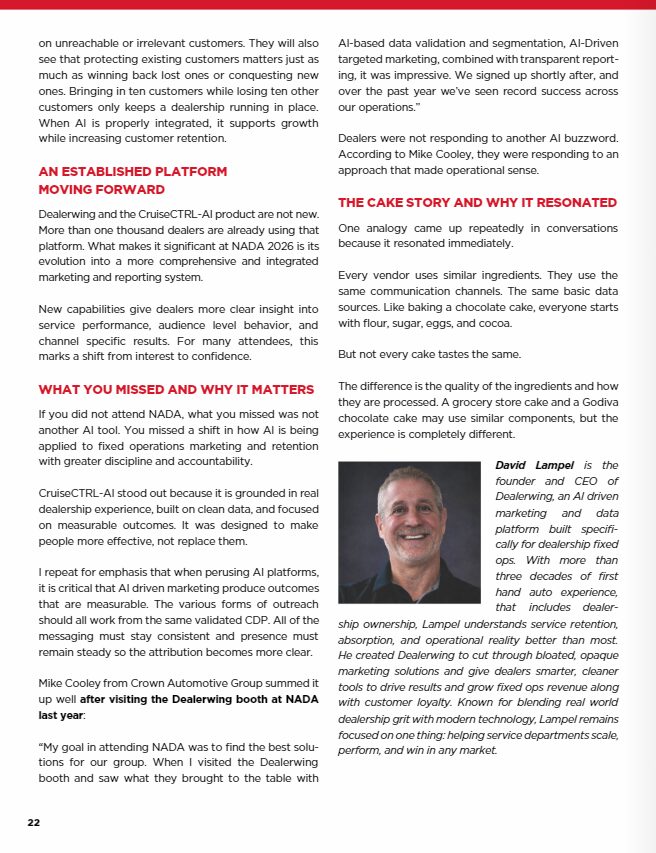
Every NADA Show has an underlying theme, whether it is formally stated or not. This year, the theme will be impossible to miss. Artificial intelligence is set up to be everywhere. Nearly every vendor is claiming to offer an AI-powered solution, workflow, or dashboard. For dealers walking the floor, it will be easy to think everyone is riding the same wave.
INDUSTRY BUZZ
The industry buzz is how AI is reshaping dealership operations. From service scheduling and retention modeling to inventory management and customer communication, AI is influencing nearly every corner of the business.
What dealers need to recognize heading into NADA is that AI itself is not the differentiator. The critical force is the data behind it. AI is only as effective as all of the information it is trained on. If the data feeding an AI platform is incomplete, outdated, duplicated, or not accurate, the output will reflect those same flaws. The old saying still applies: Garbage in. Garbage out.
CRITICAL TO FIXED OPERATIONS
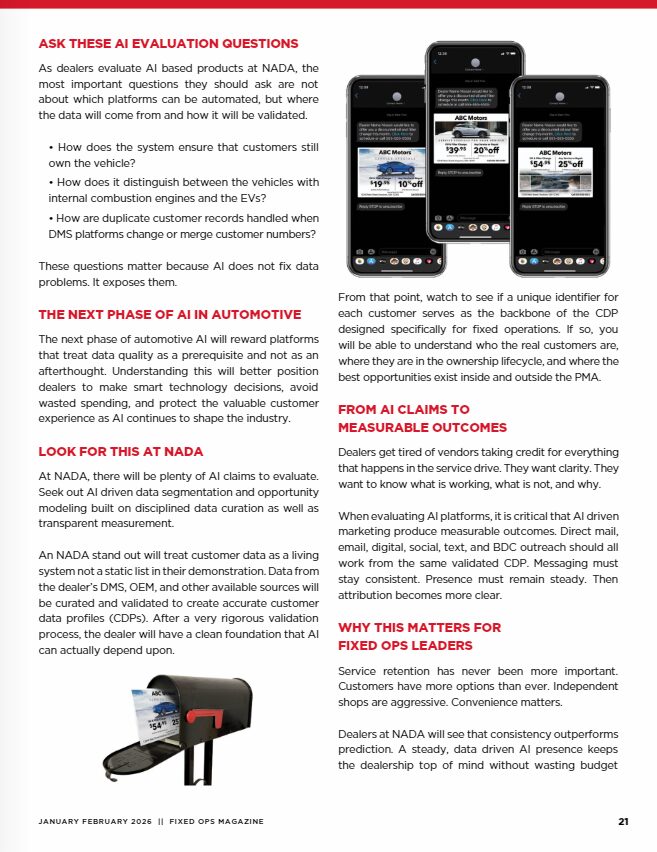
This is especially critical in fixed operations, where DMS data is often fragmented, customer records are frequently duplicated, ownership changes can be missed, and vehicle information is not necessarily consistently maintained. An AI engine making decisions based on that foundation may move faster, but not necessarily smarter.
ASK THESE AI EVALUATION QUESTIONS
As dealers evaluate AI-based products at NADA, the most important questions they should ask are not about which platforms can be automated, but where the data will come from and how it will be validated.
How does the system ensure that customers still own the vehicle?
How does it distinguish between vehicles with internal combustion engines and EVs?
How are duplicate customer records handled when DMS platforms change or merge customer numbers?
These questions matter because AI does not fix data problems. It exposes them.
THE NEXT PHASE OF AI IN AUTOMOTIVE
The next phase of automotive AI will reward platforms that treat data quality as a prerequisite and not as an afterthought. Understanding this will better position dealers to make smart technology decisions, avoid wasted spending, and protect the valuable customer experience as AI continues to shape the industry.
LOOK FOR THIS AT NADA
At NADA, there will be plenty of AI claims to evaluate. Seek out AI-driven data segmentation and opportunity modeling built on disciplined data curation as well as transparent measurement.
An NADA standout will treat customer data as a living system, not a static list in their demonstration. Data from the dealer’s DMS, OEM, and other available sources will be curated and validated to create accurate customer data profiles (CDPs). After a very rigorous validation process, the dealer will have a clean foundation that AI can actually depend upon.
FROM AI CLAIMS TO MEASURABLE OUTCOMES
Dealers get tired of vendors taking credit for everything that happens in the service drive. They want clarity. They want to know what is working, what is not, and why.
When evaluating AI platforms, it is critical that AI-driven marketing produce measurable outcomes. Direct mail, email, digital, social, text, and BDC outreach should all work from the same validated CDP. Messaging must stay consistent. Presence must remain steady. Then attribution becomes more clear.
WHY THIS MATTERS FOR FIXED OPS LEADERS
Service retention has never been more important. Customers have more options than ever. Independent shops are aggressive. Convenience matters.
Dealers at NADA will see that consistency outperforms prediction. A steady, data-driven AI presence keeps the dealership top of mind without wasting budget on unreachable or irrelevant customers. They will also see that protecting existing customers matters just as much as winning back lost ones or conquering new ones. Bringing in ten customers while losing ten other customers only keeps a dealership running in place.
When AI is properly integrated, it supports growth while increasing customer retention.
AN ESTABLISHED PLATFORM MOVING FORWARD
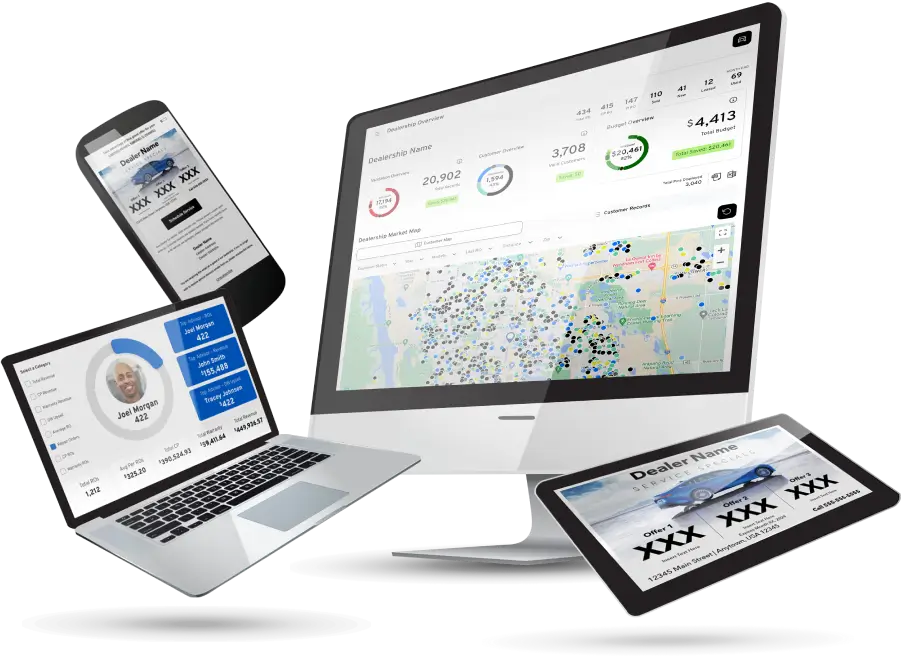
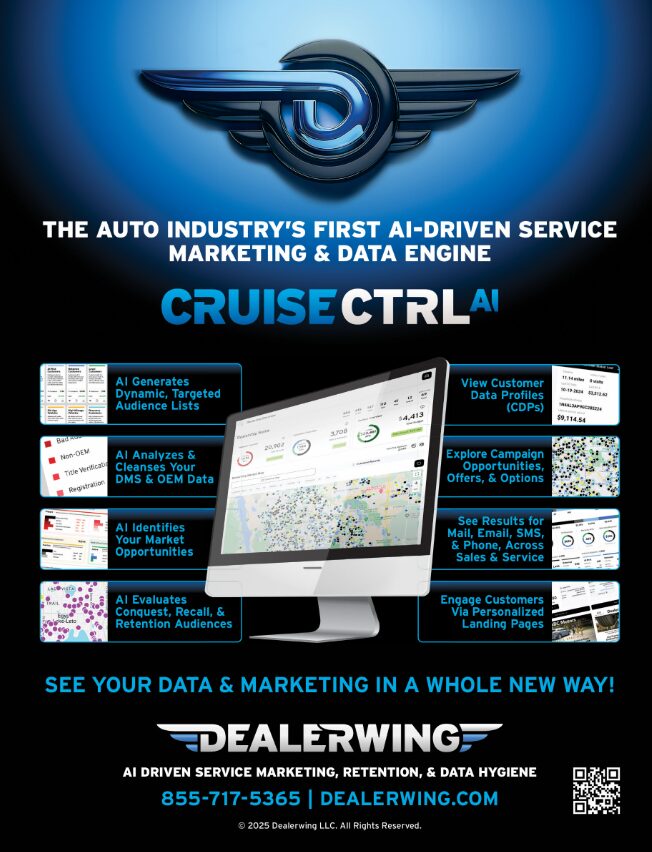
Dealerwing and the CruiseCTRL-AI product are not new. More than one thousand dealers are already using that platform. What makes it significant at NADA 2026 is its evolution into a more comprehensive and integrated marketing and reporting system.
New capabilities give dealers more clear insight into service performance, audience-level behavior, and channel-specific results. For many attendees, this marks a shift from interest to confidence.
WHAT YOU MISSED AND WHY IT MATTERS
If you did not attend NADA, what you missed was not another AI tool. You missed a shift in how AI is being applied to fixed operations marketing and retention with greater discipline and accountability.
CruiseCTRL-AI stood out because it is grounded in real dealership experience, built on clean data, and focused on measurable outcomes. It was designed to make people more effective, not replace them.
It is critical when pursuing AI platforms that AI-driven marketing produce outcomes that are measurable. The various forms of outreach should all work from the same validated CDP. All messaging must stay consistent and presence must remain steady so that attribution becomes more clear.
Mike Cooley from Crown Automotive Group summed it up well after visiting the Dealerwing booth at NADA last year:
“My goal in attending NADA was to find the best solutions for our group. When I visited the Dealerwing booth and saw what they brought to the table with AI-based data validation and segmentation, AI-driven targeted marketing, combined with transparent reporting, it was impressive. We signed up shortly after, and over the past year we’ve seen record success across our operations.”
Dealers were not responding to another AI buzzword. According to Mike Cooley, they were responding to an approach that made operational sense.
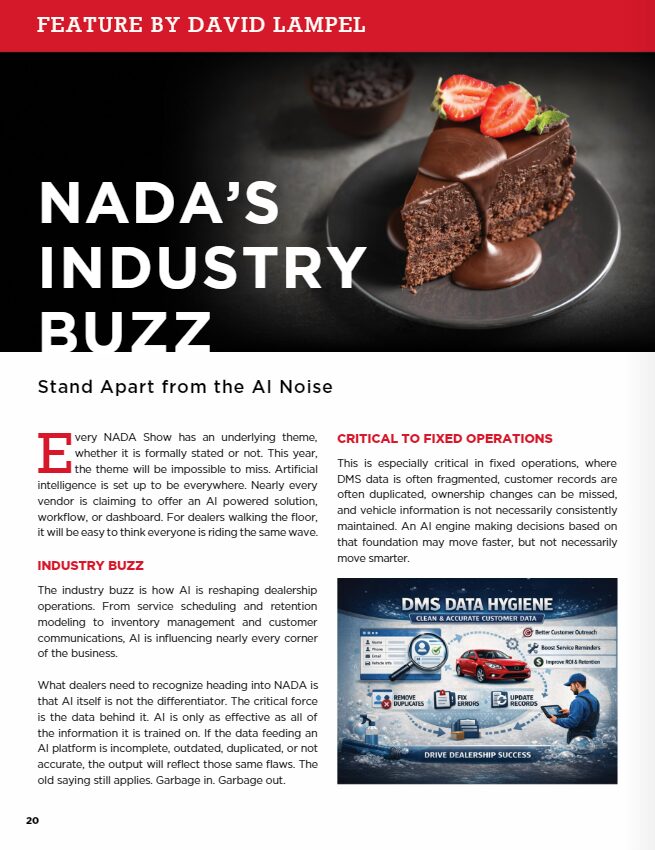
THE CAKE STORY AND WHY IT RESONATED
One analogy came up repeatedly in conversations because it resonated immediately.
Every vendor uses similar ingredients. They use the same communication channels. The same basic data sources. Like baking a chocolate cake, everyone starts with flour, sugar, eggs, and cocoa.
But not every cake tastes the same.
The difference is the quality of the ingredients and how they are processed. A grocery store cake and a Godiva chocolate cake may use similar components, but the experience is completely different.
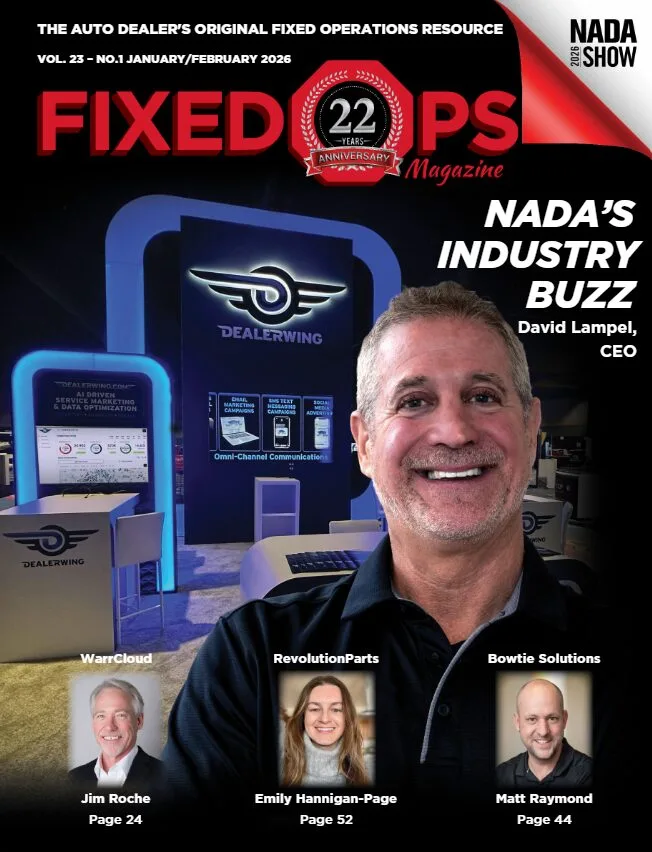
FEATURED IN FIXEDOPS MAGAZINE (JAN 2026)
By David Lampel
David Lampel is the founder and CEO of Dealerwing, an AI-driven marketing and data platform built specifically for dealerships’ fixed operations. With more than three decades of firsthand auto experience that includes dealership ownership, Lampel understands service retention, absorption, and operational reality better than most. He created Dealerwing to cut through bloated, opaque marketing solutions and give dealers smarter, cleaner tools to drive results and grow fixed ops revenue along with customer loyalty. Known for blending real-world dealership grit with modern technology, Lampel remains focused on one thing: helping service departments scale, perform, and win in any market.
Schedule a Demo
THOUGHTS ON DMS MARKETING FOR 2026
By Dave Page, Operating Partner at Dealerwing
As the industry heads into NADA 2026, the gap between modern service marketing expectations and legacy DMS-driven systems is becoming increasingly clear. Most dealers are marketing consistently. The issue is not effort. The issue is accuracy.
Over time, DMS data becomes fragmented. Customer records are duplicated. Ownership changes are missed. Vehicle details are incomplete. In many dealerships, thirty to forty percent of the database is no longer reliably marketable. That means a significant portion of service marketing spend is directed toward customers who will never see, trust, or respond to the message.
As EV adoption increases, these gaps become more visible. Sending an oil change reminder to an EV owner does more than waste money. It erodes credibility.
In recent months, industry publications have focused heavily on AI and automation as the next frontier in dealership operations. AI will undoubtedly play a major role in fixed ops marketing going forward, but there is an important truth that often gets overlooked. AI is only as effective as the data behind it. When inaccurate or incomplete data feeds automation, the results are faster mistakes, not better outcomes.
In the next issue of Fixed Ops Magazine, I will take a deeper look at how DMS data quality impacts service retention as well as the customer experience and marketing ROI. We will explore why consistency outperforms prediction, how fragmented vendor strategies create unintended customer frustration, and what fixed ops leaders should be asking of any AI-driven marketing solutions they evaluate.
Before adding more tools, the industry needs to address their current foundation.
The full article will examine what that foundation looks like and why it matters now more than ever.